Forty-three percent of women pack at least one outfit they never wear on a trip. That figure comes from a 2019 OnePoll survey, and anyone who has traveled with a checked bag knows it is probably an undercount. The Yumi postcard dress sits in the middle of this problem — beautiful enough on the product page to feel essential during packing, then either earning its place or sitting folded and untouched. Here is what three trips actually revealed.
What the Yumi Postcard Dress Actually Is
The name covers multiple dresses. That is the first thing to clarify.
Yumi London has been producing bold, print-driven womenswear since 1990. Not fast fashion in the weekly micro-collection sense — but not slow fashion either. Production sits at the standard for this price tier: primarily manufactured in Asia, with limited published transparency about their supply chain. They do have a sustainability page, but it is light on specifics. Worth knowing if ethical sourcing informs your decisions.
Retail price runs £45 to £85 on their own site, or roughly $55–$105 USD depending on exchange rates. Available through ASOS, Next, and House of Fraser alongside their direct channel. Solidly mid-market — not budget, not premium.
What “Postcard Print” Actually Means
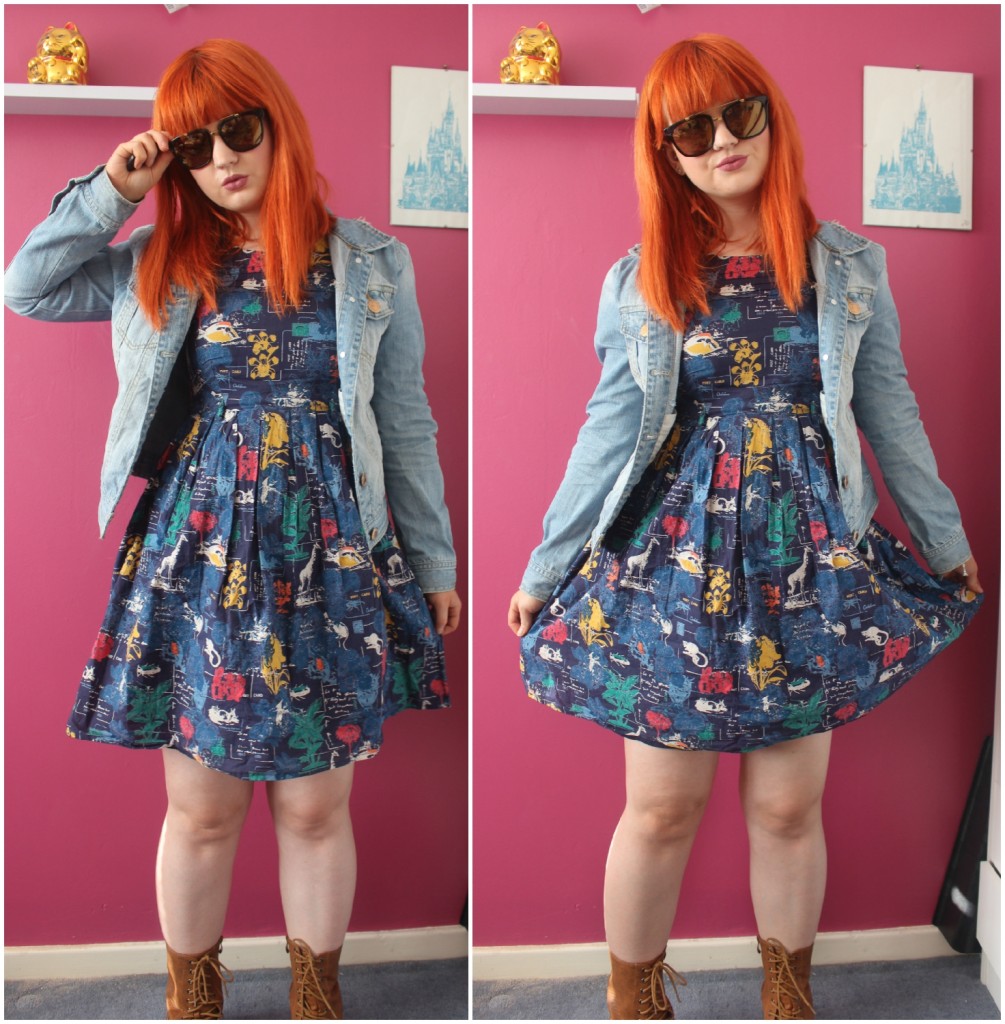
The prints are the point. Dense, illustration-style designs — not the vague tropical pattern that flooded every high-street rack for a decade. A Yumi postcard print typically shows detailed drawings: Parisian cafes, Italian coastlines, Mediterranean boats, or exotic birds layered against cream, navy, or rust backgrounds. The aesthetic draws directly from vintage travel ephemera. It photographs exceptionally well, which is precisely why it circulated across Pinterest travel boards for three consecutive years.
The fabric under those prints matters more than the pattern. Most printed versions use 100% polyester. Some structured styles use a 70% viscose/30% polyester blend. Polyester compresses without trapping air, resists wrinkles, and machine washes at 30°C. Viscose blends have better drape and look more refined, but crease badly after a long flight and generally need hand washing or delicate cycles. Check the label before ordering — the product name alone will not tell you which you are getting.
The Four Silhouettes Worth Knowing
Yumi produces at least four distinct shapes under the postcard label:
- Wrap midi — ties at the waist, adjustable fit, most forgiving across body shapes
- Fit-and-flare — defined waist, A-line skirt, no size adjustment built in
- Shift dress — boxy, falls straight, most comfortable after a long flight or generous meal
- Smock or ruffle style — more decorative, less useful for packing
For travel versatility, the wrap midi wins without much contest. The adjustable waist absorbs size fluctuations that happen during travel — long meals, flights, walking 20,000 steps a day. The fit-and-flare looks sharper at dinner but commits you to a fixed fit. The shift is the most forgiving if you are ordering online without trying first.
Sizing: Order One Size Up
This is consistent across their entire range, not just the postcard styles. Their size guide is optimistic. A standard UK 12 should order a 14; a UK 14 should order a 16. Returns are free within the UK and fee-based from outside, so if you are ordering internationally, build in lead time before your trip rather than gambling on getting the size right first try. Cross-referencing Yumi listings on ASOS helps — customer reviews there flag sizing and fit issues more reliably than Yumi’s own product pages.
Fit, Fabric, and Pack Performance — By the Numbers
The wrap midi rolls to approximately 20x10cm — about the footprint of a thick paperback. On a direct packing comparison, I fit it alongside a Reformation Jersey Dress ($178) and an Anthropologie Maeve wrap ($108) into a single medium packing cube with room remaining. The Yumi occupied the least space by a visible margin — entirely because 100% polyester compresses without trapping air the way jersey or linen does.
| Feature | Yumi Postcard Wrap Midi | What It Means for Travel |
|---|---|---|
| Fabric | 100% Polyester | Wrinkle-resistant, quick-dry, but warm above 28°C |
| Price (UK) | £45–£85 | Sits between ASOS Premium and & Other Stories pricing |
| Packed size | Approx. 20x10cm rolled | Same footprint as a thick paperback book |
| Wrinkle recovery | Excellent | Hangs out within 30 minutes; no steaming needed |
| Care | Machine wash 30°C | Works in hotel laundrettes; no specialist care required |
| Sizing accuracy | Runs 1 size small | Order up from your usual Yumi size |
| Day-to-evening versatility | High | Sandals for sightseeing; heeled mules or ankle boots for dinner |
The wrinkle recovery is genuinely above average for this price point. After 10 hours compressed in a packing cube on a long-haul flight, 30 minutes hanging in a bathroom with the shower running hot cleared most of the fold lines. That is not a marketing claim — it is the practical outcome of flying polyester, which is exactly why it remains the fabric of choice for travel clothing at this tier.
The One Packing Rule That Cuts Your Bag in Half
Before buying any travel dress, including this one, apply a single filter: can you wear it to three distinct types of occasion without changing the dress itself?
Morning at a market. Lunch at a mid-range restaurant. Dinner somewhere that requires a little thought.
If the answer is no, it is not a travel dress. It is a dress you are taking on a trip.
Why Most Clothes Fail This Test
The fashion industry markets a lot of clothing as travel-appropriate without it meeting any practical standard. “Travel” in marketing usually means the garment was photographed in front of cobblestones or a harbour — not that it actually performs across multiple settings without requiring a full wardrobe change.
Any dress that only works for one context takes up general-purpose space in your bag while serving a specialized function. The three-context filter clears this out before you pack. Anything that cannot pass — leave it home. The pieces that do pass are your actual travel wardrobe, not a wishful collection of aspirational outfits.
Accessories That Do the Heavy Lifting
Three accessories cover most travel situations. A plain linen or cotton blazer in cream, navy, or tan flips the formality of almost any dress entirely — the bold Yumi print reads as intentional, the blazer signals effort. Leather sandals handle most evenings in warm climates. Ankle boots push the dress into autumn or cooler settings. Two pairs of shoes for an entire trip. Extra shoes are how people end up checking a bag for a five-day city break.
Tip: Before any trip, search your destination name plus “dress code” plus the month you are visiting. Local travel forums and subreddits are far more accurate than guidebook advice on what is actually appropriate — particularly for temples, religious sites, and local restaurants that do not primarily cater to tourists.
Where the Postcard Dress Fails You
The marketing leans hard on the travel narrative, which is fair given the prints. But specific situations make this dress a genuinely poor choice, and the product page will not mention any of them.
- Extreme heat above 30°C: Polyester does not breathe adequately in genuinely tropical temperatures. In Hanoi in July, this dress was uncomfortable by 10:30am. A linen alternative — Seasalt Cornwall’s Jetty Dress (~£65, linen mix) or a basic M&S linen shift — performs substantially better when heat is the dominant variable.
- Conservative destination dress codes: The prints are bold and visible from distance. Visiting temples, mosques, or rural communities where modest dress is the norm means this draws attention you do not want. A plainer, longer alternative is the more practical choice.
- Long-haul flights: Polyester clings to airplane seats after a few hours. On 12+ hour flights, loose cotton or jersey is significantly more comfortable. Pack the Yumi in your carry-on and change on arrival — 10 minutes in an airport bathroom, and you are ready.
- Tight budgets or high-risk environments: Multi-week backpacking with regular hostel laundry, or travel to destinations with higher theft risk, puts a £65 dress at real exposure. ASOS carries direct visual equivalents — Influence-brand postcard-print midis from around £22 — that pack identically and look nearly the same from any reasonable distance. The quality difference is visible under close inspection. Most people do not inspect your dress at close range.
- Limited size range: Yumi currently caps at UK 20, which is less inclusive than ASOS Curve or Eloquii. The wrap style also proportions differently at the outer edges of their range — worth checking their specific fit notes before ordering.
Tip: For destinations where you are genuinely uncertain whether a patterned dress is appropriate, a plain modest alternative takes up the same space in a bag and removes the guesswork entirely. Bold prints become a liability anywhere blending in is the smarter strategy.
Yumi vs. Real Alternatives: A Direct Comparison
Buy the Yumi postcard wrap midi if you want something visually distinctive that covers most mild-to-warm climate travel situations. Do not default to it just because it says “travel” — compare it against what else exists at a similar price first.
| Dress | Price | Fabric | Best Climate | Verdict |
|---|---|---|---|---|
| Yumi Postcard Wrap Midi | £45–£85 | 100% Polyester | Mild to warm (15–28°C) | Best visual impact; not ideal above 30°C |
| Reformation Jersey Dress | $178 (~£140) | TENCEL Jersey | Year-round | Best quality and feel; hardest to justify for a single trip |
| Anthropologie Maeve Wrap | $108 (~£85) | Rayon blend | Mild climates only | Looks expensive; creases badly, requires careful washing |
| Athleta Santorini Dress | $89 (~£70) | Nylon-spandex | Active travel, all climates | Best for adventure-heavy itineraries; noticeably sporty aesthetic |
| Seasalt Cornwall Jetty Dress | £65 | Linen mix | Hot and warm climates | Best breathability; prints less adventurous than Yumi |
When Reformation Justifies the Price
The Reformation Jersey Dress ($178) wins on fabric quality, TENCEL’s environmental credentials versus polyester, and long-term wearability. If you travel twice a year and plan to wear this across multiple trips and seasons, the cost-per-wear math eventually closes the gap. For a single trip, paying £140 against the Yumi’s £65 is hard to defend — the Yumi delivers roughly 80% of the same result at half the price. The Reformation earns its premium over time, not on one holiday.
When Athleta Is the More Honest Pick
The Athleta Santorini Dress ($89) solves a different problem entirely. Engineered for movement — hiking trails to dinner tables, boat trips to city streets — the nylon-spandex fabric dries in about two hours and needs no ironing. Less stylish than the Yumi in a strictly aesthetic sense. But for active-heavy itineraries where you are sweating before noon and need the dress ready again by dinner, the Athleta is the more honest choice than buying the Yumi and regretting it by day three.
Bottom Line
For European city travel and Southeast Asian trips in shoulder season, the Yumi postcard wrap midi earns its £55–£75 price. Order one size up, confirm you are getting the 100% polyester version, and accept that it is uncomfortable above 30°C. That is the complete honest read.
- Best for: Mediterranean cities, Southeast Asia in spring or autumn, UK and European city weekends
- Wrong for: Tropical heat destinations, conservative dress code contexts, active or hiking-heavy itineraries
- Size rule: One size up from your usual Yumi size, without exception
- Budget alternative: ASOS Influence postcard-print midi dresses (~£22)
- Premium alternative: Reformation Jersey Dress ($178) for frequent travelers who can amortize the cost across multiple trips
Not financial advice — but £65 worn eight times outperforms £22 worn once and left at the bottom of a suitcase.