Berlin rewards planning. More than almost any other European capital, its neighborhoods hold distinct identities — shaped by division, reunification, and decades of contested history — and poor routing burns time this city actually deserves.
What follows is a documented, realistic sequence for 24 hours in Berlin. Timed for the constraints most visitors face. Priced as accurately as publicly available information allows. And honest about what is worth your time versus what merely looks like it should be.
This is not a substitute for checking current opening hours and prices directly with venues — admission costs and access in Berlin can shift seasonally, and several major sites are in ongoing renovation as of 2026.
The Full 24-Hour Schedule at a Glance
The routing below moves roughly west to east through central Berlin before finishing south in Kreuzberg. It minimizes backtracking, which is the primary way day-trip itineraries lose 45 to 90 minutes unnecessarily.
| Time | Activity | Neighborhood | Estimated Cost |
|---|---|---|---|
| 7:00–8:30 AM | Breakfast and Brandenburg Gate | Mitte / Tiergarten | €8–12 food; Gate free |
| 8:30–10:00 AM | Holocaust Memorial and Reichstag exterior | Mitte | Free (dome requires advance booking) |
| 10:00 AM–12:30 PM | Museum Island — Neues Museum or Altes Museum | Museumsinsel | €12–18 |
| 12:30–1:30 PM | Lunch near Hackescher Markt | Mitte | €10–18 |
| 1:30–3:30 PM | East Side Gallery walk | Friedrichshain | Free |
| 3:30–5:30 PM | Topography of Terror | Mitte | Free |
| 5:30–7:00 PM | Prater Garten beer garden | Prenzlauer Berg | €5–15 |
| 7:30–9:30 PM | Dinner — Bergmannstraße corridor | Kreuzberg | €15–35 |
| 9:30 PM onward | Bar or music venue | Kreuzberg / Neukölln | €5–20 |
This schedule works Tuesday through Saturday. Monday is the worst day — several Museum Island buildings close entirely, including the Alte Nationalgalerie. Sunday brings crowds to Museum Island and limited restaurant options in some neighborhoods. If you have any flexibility in travel dates, Tuesday through Thursday typically offers the most workable conditions.
Morning — Start in Mitte Before the Tour Groups Arrive
Arrive at the Brandenburg Gate before 8:30 AM. By 10 AM the Pariser Platz — the square the Gate faces — typically fills with organized tour groups, costumed photo vendors, and ambient noise that makes thoughtful engagement with the space difficult.
Brandenburg Gate and Holocaust Memorial (7:30–9:00 AM)
The Gate is free, open around the clock, and takes about 20 minutes if approached correctly. Don’t just photograph the west face. Walk through the Gate and look east along Unter den Linden, the 1.5km boulevard running toward Museum Island. That east-facing view gives immediate spatial context for how central Berlin was organized before and after the Wall.
From the Gate, the Memorial to the Murdered Jews of Europe is a 4-minute walk south along Ebertstraße. Designed by architect Peter Eisenman and opened in 2005, the installation covers 2.7 hectares with 2,711 concrete stelae of varying heights arranged in a grid. The exterior is always accessible and deserves 20 to 30 unrushed minutes. The underground Documentation Center beneath the memorial provides historical context through documents, photographs, and individual victim histories. Timed entry is required for the Documentation Center during busy periods — book through the Stiftung Denkmal website. Entry is free.
The Reichstag dome is 10 minutes’ walk from the Gate. The dome experience — a walkable glass spiral with 360-degree views over central Berlin — requires a reservation made typically two to four weeks in advance through the Bundestag’s official booking system. Walk-in access is not available. If you have a booking, slot it between 8:30 and 10 AM. If not, note the exterior and move on.
Museum Island — Pick One, Not All Five
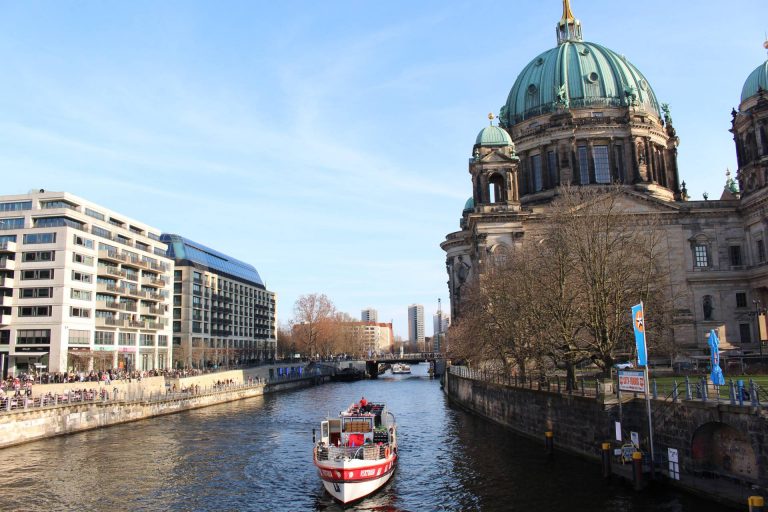
Museum Island (Museumsinsel) is a UNESCO World Heritage Site with five museums on a narrow island in the Spree. In 24 hours, attempting more than one results — in most travelers’ reported experience — in a blur of artifacts without retained context. Pick one and go deep.
The Pergamon Museum is the most famous option, but its main hall containing the Pergamon Altar has been closed for structural renovation since 2026 and is expected to remain closed through at least 2027. Visitors can access the Islamic Art wing and portions of the Antiquities collection, including the Ishtar Gate from Babylon. Admission reflects the partial closure at approximately €12, down from the usual €19.
For a single 24-hour visit, the Neues Museum is the stronger recommendation. It holds the bust of Nefertiti — one of the most recognized artifacts in any European collection — alongside substantial Egyptian and prehistoric Germanic displays. The building itself, reconstructed by architect David Chipperfield after near-total WWII destruction, preserves ruin fragments within the new structure in a way that makes the building part of the exhibition. Entry is €18; timed tickets are strongly advised. The Altes Museum next door covers Greek and Roman antiquities, generally carries shorter wait times, and charges €12 for individual entry.
The Museum Island day pass (Tageskarte) at €29 covers all five museums. For a 24-hour visit where you will realistically enter one or two buildings, individual tickets typically cost less. The math only favors the day pass if you are extending your visit across multiple days.
The Single Biggest Mistake Visitors Make in 24 Hours
Checkpoint Charlie. The guardhouse structure at Friedrichstraße is a fiberglass replica — not a preserved original — and the commercial museum operating nearby has been repeatedly criticized by historians for prioritizing revenue over accuracy. The actual history of this crossing — the 1961 tank standoff between American and Soviet forces, the documented escape attempts made here — is covered with more precision and at no charge at the Topography of Terror, 800 meters away.
Afternoon — East Side Gallery and the Topography of Terror
From Hackescher Markt, take the S3, S5, S7, or S9 two stops east to Ostbahnhof. From the station’s south exit, the East Side Gallery is a 5-minute walk along Mühlenstraße.
East Side Gallery (1:30–3:30 PM)
The East Side Gallery is 1.3km of original Berlin Wall, preserved as an open-air gallery with 105 murals painted by international artists in 1990. Access is free and continuous — no entry point, no closing time. Walk it west to east from the Ostbahnhof end and look for these in sequence:
- Approximately 200m from the Ostbahnhof entrance: Dmitri Vrubel’s My God, Help Me to Survive This Deadly Love — the famous painting of Brezhnev and Honecker. The most photographed mural on the stretch by a significant margin.
- Continuing east: Birgit Kinder’s Test the Best — a Trabant driving through the Wall. The second most recognized image.
- At the eastern end: the Oberbaumbrücke, a neo-Gothic red-brick bridge crossing the Spree. It connects Friedrichshain on the north to Kreuzberg on the south and marked the border between the two zones — a clean visual close to the walk.
The murals vary significantly in quality, and at least a dozen have been repainted since 1990 with disputed accuracy. The Gallery Sixteen, embedded within the stretch, sells reproductions commercially. This context is worth having as you walk — the East Side Gallery is both a genuine historical artifact and an active commercial property, and those two things coexist in ways that are not always clearly signposted.
Topography of Terror (3:30–5:30 PM)
From the East Side Gallery, the U1 from Schlesisches Tor or the U8 from Moritzplatz reaches the Topography of Terror in under 15 minutes. Nextbike and Lime rentals are available along Mühlenstraße for a 12-minute cycling route through Kreuzberg if conditions favor it.
The Topography of Terror occupies the former site of the SS and Gestapo headquarters on Niederkirchnerstraße. Admission is free. Hours are 10 AM to 8 PM daily in summer, 10 AM to dusk in winter. The indoor exhibition — roughly 800 square meters of documented evidence — covers the organizational structure of the SS, the mechanisms of persecution, and the administrative processes that made systematic terror operationally manageable for ordinary bureaucrats. It is sobering material presented without dramatization and without commercial mediation. Allow 90 minutes minimum to move through the indoor content without rushing. The outdoor excavation area alongside a standing section of the Berlin Wall along Niederkirchnerstraße is accessible before and after the indoor exhibition closes.
Getting Around Berlin — Transport Questions Worth Answering
Do I need a BVG day ticket?
Almost certainly yes. The BVG (Berliner Verkehrsbetriebe) Tageskarte for zones AB costs €10.40 as of 2026. A single journey costs €3.80. The day ticket covers its cost after three trips, and the itinerary above involves at minimum five to six separate journeys. Buy it from the yellow ticket machines at any U-Bahn or S-Bahn station — card and cash both accepted. Validate it immediately at the stamp machines on the platform. Unvalidated tickets are not accepted by inspectors regardless of purchase time.
Which zones cover tourist areas, and what about the airport?
Zone AB covers all central Berlin attractions referenced here: Museum Island, Brandenburg Gate, East Side Gallery, Kreuzberg, Prenzlauer Berg, Friedrichshain. Zone C adds the surrounding Brandenburg region, including BER Berlin Brandenburg Airport in Schönefeld. The ABC Tageskarte is €11.80 — only €1.40 more than AB — and makes clear sense if you are arriving from or departing to BER on the same day. Tegel airport is permanently closed as of 2026. All commercial flights use BER.
Is a rental bike faster than the U-Bahn for this route?
For the Museum Island to East Side Gallery to Topography of Terror segment: yes, typically. Berlin has one of the more developed urban cycling infrastructures among major German cities. Nextbike day passes run approximately €9–15 depending on duration; Lime e-bikes charge per minute at around €0.25–0.35 plus a €1 unlock fee. For riders comfortable with urban cycling, the route along the Spree riverbank is mostly flat, scenic, and faster door-to-door than the S-Bahn for afternoon legs. For anyone unfamiliar with German cycling traffic rules: the U-Bahn is the lower-risk choice.
Evening — Prenzlauer Berg First, Then Kreuzberg
Skip the hotel restaurant. Berlin’s evenings belong to the neighborhoods, and the measurable difference between what you’ll eat near the central tourist corridor versus 10 minutes by U-Bahn in Kreuzberg or Prenzlauer Berg makes the extra travel straightforwardly worth it.
Prater Garten (5:30–7:00 PM)
Prater Garten on Kastanienallee in Prenzlauer Berg has operated as a beer garden since 1837, making it Berlin’s oldest. Up to 600 seats under chestnut trees, straightforward German beer — Pils, Kellerbier — without the tourist markup common near Mitte. A half-liter typically runs €4.50–5.50. Kitchen service ends before bar service, so arrive by 6:30 PM if you want food here rather than just beer.
Dinner and Late Evening in Kreuzberg (7:30 PM Onward)
The Bergmannstraße corridor — between Mehringdamm and Zossener Straße U-Bahn stations in Kreuzberg — concentrates Turkish, Middle Eastern, and modern German restaurants at a density that makes finding a solid dinner without a reservation reliably possible. This is Kreuzberg’s most accessible stretch for visitors with limited neighborhood familiarity.
Curry 36 on Mehringdamm is the most referenced currywurst counter in Berlin, cited regularly in German food writing as the standard against which others are measured. It is a street stand. A serving runs €4–6. Treat it as a mandatory reference point rather than a meal — order one, establish the benchmark, eat properly at a sit-down restaurant afterward.
For nightlife: Tresor on Köpenicker Straße has operated as a techno venue since 1991 and currently runs in a converted power plant. It opens at 11 PM on weekends, charges €12–15 entry, and the space itself is worth seeing even if you stay an hour. Berghain operates Friday and Saturday nights only, opens at midnight or later, and has door policies that experienced Berlin visitors generally describe as genuinely unpredictable regardless of preparation. On a 24-hour itinerary with a morning departure, it does not fit. Weserstraße in Neukölln — a 15-minute walk south from Kottbusser Tor — offers a quieter alternative: bars that welcome strangers without queuing ritual, at lower cost, and with more predictable access.
The most useful thing a visitor can take away from 24 hours in Berlin is spatial context: the city’s layout is a direct artifact of its division, and every monument, museum, and neighborhood reads differently once you know where East met West.